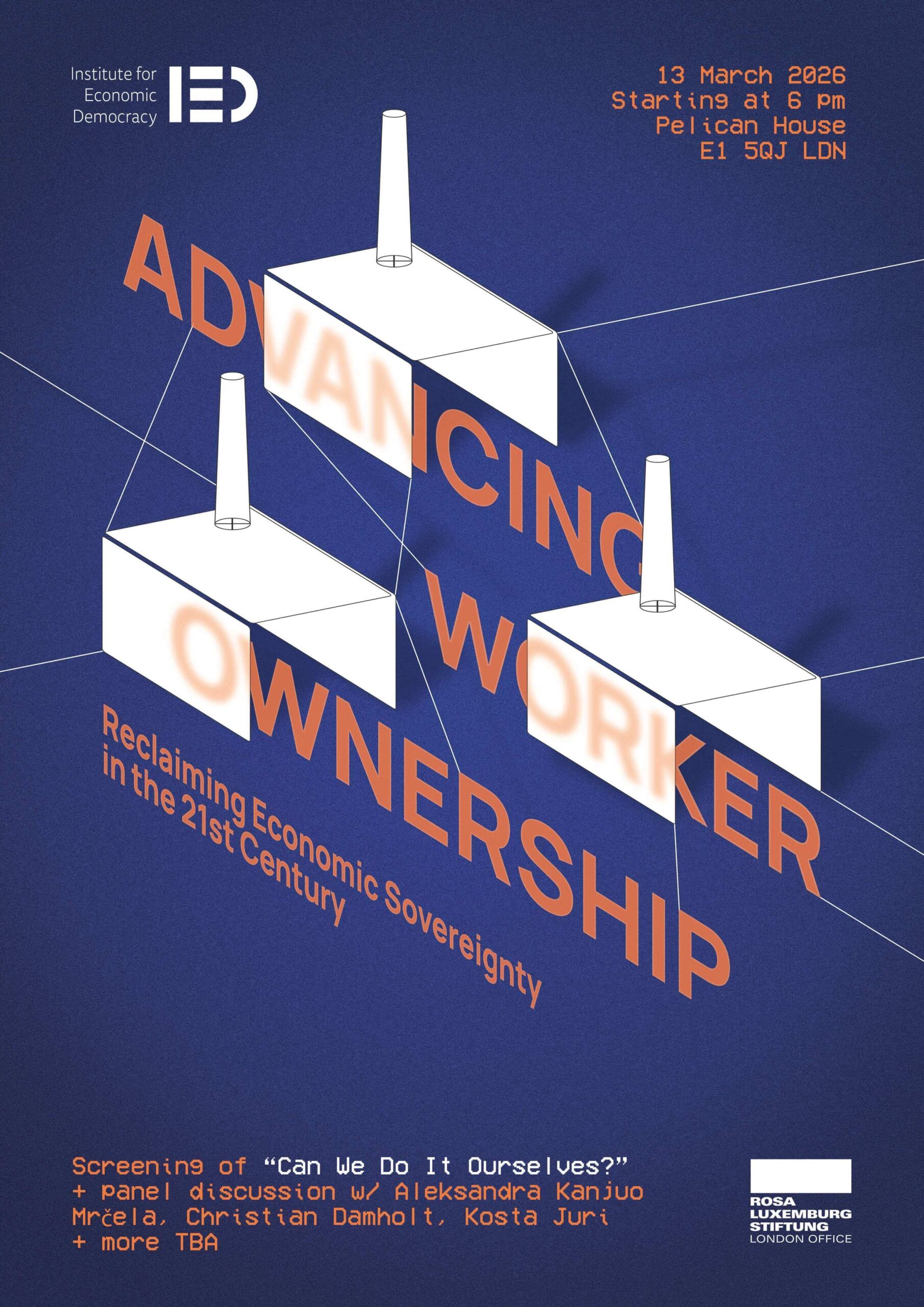
Advancing Worker Ownership: Reclaiming Economic Sovereignty in the 21st Century

Films & Performances

Businesses have become more mobile, more complex, and less accountable. Decisions that shape our lives (such as relocations, layoffs and investments) are increasingly made far from the communities they affect the most, while traditional tools of regulation and trade unions struggle to keep up. If we want to protect democracy and economic sovereignty, we must rethink ownership itself.

Democratic worker ownership offers a radical yet practical and time-tested alternative. It anchors wealth, jobs, and decision-making locally, strengthening democracy at work and beyond and giving people a sense of agency over their lives. It reduces inequality not only through redistribution, but by reshaping how value is created and shared in the first place. And as if this wasn’t enough, it’s even good for business; worker-owned firms consistently prove resilient and competitive.

Today, worker ownership remains marginal virtually everywhere, being held back by institutional bias, financing barriers, and limited awareness. But is that changing? What can we learn from the rise of Employee Ownership Trusts (EOTs) in the UK? And what legislation is emerging in other countries, particularly in Slovenia, Denmark, and Spain?

Join us for an evening dedicated to exploring these questions. There will be a film screening of Can We Do It Ourselves? (2018) by Patrik Witkowsky, followed by a panel discussion featuring Aleksandra Kanjuo-Mrčela, Benjamin Braun, Christian Damholt and Kosta Juri, among others.

Businesses have become more mobile, more complex, and less accountable. Decisions that shape our lives (such as relocations, layoffs and investments) are increasingly made far from the communities they affect the most, while traditional tools of regulation and trade unions struggle to keep up. If we want to protect democracy and economic sovereignty, we must rethink ownership itself.

Democratic worker ownership offers a radical yet practical and time-tested alternative. It anchors wealth, jobs, and decision-making locally, strengthening democracy at work and beyond and giving people a sense of agency over their lives. It reduces inequality not only through redistribution, but by reshaping how value is created and shared in the first place. And as if this wasn’t enough, it’s even good for business; worker-owned firms consistently prove resilient and competitive.

Today, worker ownership remains marginal virtually everywhere, being held back by institutional bias, financing barriers, and limited awareness. But is that changing? What can we learn from the rise of Employee Ownership Trusts (EOTs) in the UK? And what legislation is emerging in other countries, particularly in Slovenia, Denmark, and Spain?

Join us for an evening dedicated to exploring these questions. There will be a film screening of Can We Do It Ourselves? (2018) by Patrik Witkowsky, followed by a panel discussion featuring Aleksandra Kanjuo-Mrčela, Benjamin Braun, Christian Damholt and Kosta Juri, among others.