
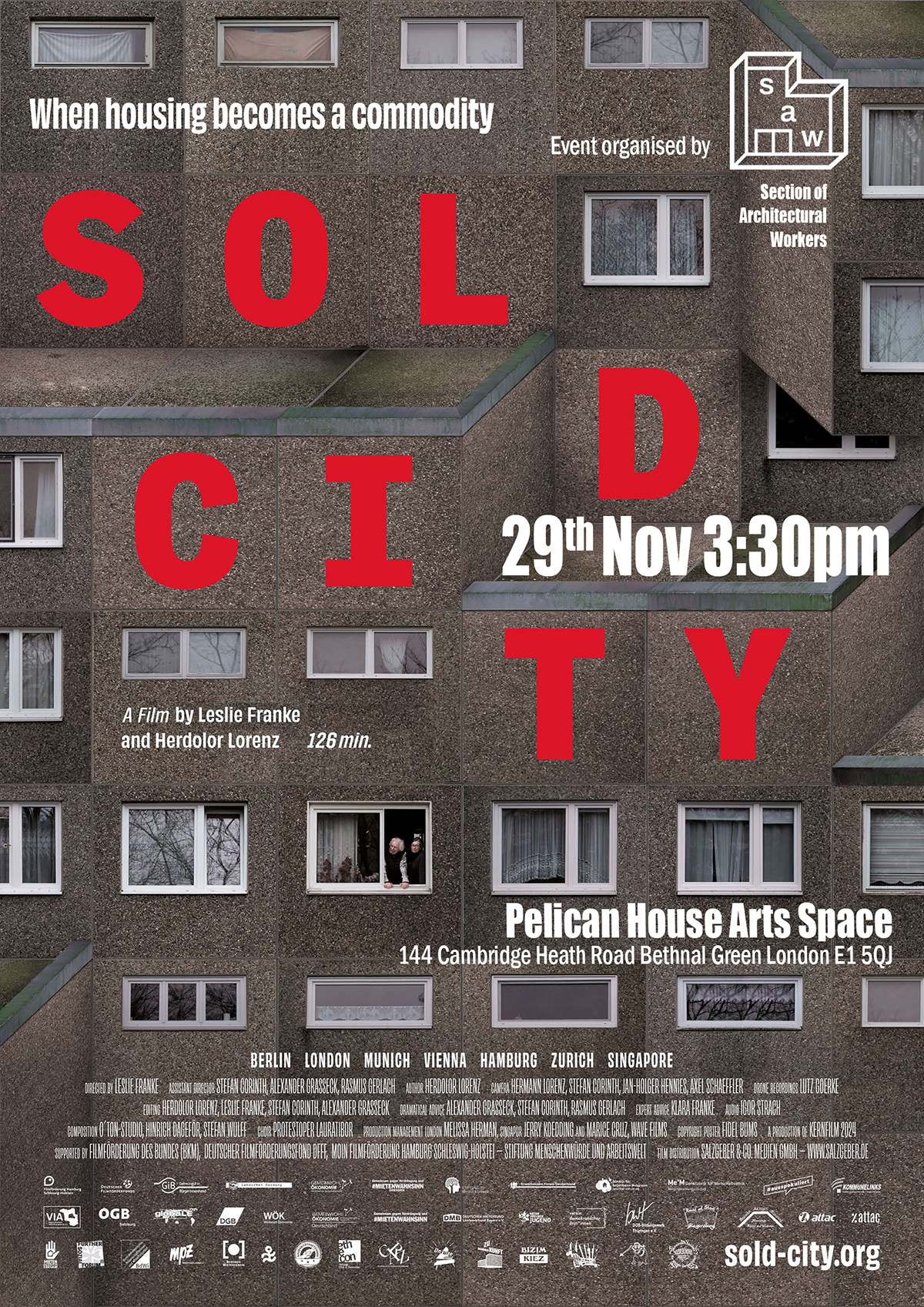
SOLD CITY – When Housing Becomes a Commodity (+ Q&A)

Films & Performances

Film by Leslie Franke and Herdolor Lorenz | Length: 126 minutes (German with English subtitles)

Film screening + Q&A with film directors

This event is hosted by the Section of Architectural Workers (SAW), part of Unite the Union. We are currently developing a housing group to bring together architectural workers and housing campaigners, connecting the struggles we face within our workplaces with the exploitation, insecurity and inequality we experience in housing.

About the film:

Since the non-profit status of housing was abolished in Europe, housing is no longer considered a human right. With the market deciding where we should live, one might ask how will the housing issue be resolved in the 21st century? Using Berlin, Paris, Hamburg, Munich, London and Vienna as examples, “SOLD CITY” provides real-life insight into how those affected experience the real estate boom and what options they have to resist it.

For more than a decade, we have been experiencing a unique real estate boom in the world’s metropolis. This has a mirror-image flip side: sharply rising rents, income growth is no longer keeping pace, and low- and medium-income citizens are threatened with displacement from sought-after inner-city locations. A turning point was reached when politicians in Europe decided to end the so-called “non-profit housing system”.

The social purpose of housing is no longer the most important aspect of housing policy. Instead, it is the return on investment that housing generates that is the real drive of policy makers.

Real estate companies such as Vonovia and Deutsche Wohnen, LEG, ADO Properties, Covivio, Akelius, TAG Immobilien Grand City Properties, CDC Habitat dominate the housing market increasingly all over Europe. They make record profits that industries cannot even dream of achieving. The owners are anonymous pension and investment funds from all over the world, which – in search of profitable investment opportunities – have discovered “concrete gold” for themselves after the 2008 financial crisis.

The expectation of a return on investment is changing the urban landscape. Not only in city centres such as Paris and London do we witness visible degeneration into an museum -like scenery for tourists and rich apartment owners. Now, neighbourhoods, evolved over time are being transforming into up-market, fashionable districts showcasing the same expensive art and pop culture one finds everywhere. These are the places where working people stream in from the suburbs in the morning, to then disappear by night, no longer able to afford to rent property here.

Hence, the film will explore the question of how people experience the real estate boom, where the rent increases come from, and what possibilities there are to resist it.
“SOLD CITY” not only makes the dangers for urban culture visible, but demonstrates the immense danger for democracy in our world cities. Finally, it will ask whether it is justified that land, which is finite, with its immense increases in value has been commoditized.

More information about the film here.